SMS vs Email for Sending Quotes: Which Gets More Solar and Electrical Jobs Signed?
You’ve spent 45 minutes putting together a solar quote. System sizing done. Equipment specified. STC rebate calculated. Proposal formatted professionally.
Now you need to send it.
Most solar installers and electricians default to email. It’s what they’ve always done. It feels professional. The quote looks good on a laptop screen.
But here’s the problem: the customer reads it on their phone, if they open it at all.
This article gives you a direct comparison of SMS and email for quote delivery in the Australian solar and electrical trades — what the data shows, what experienced installers have found in practice, and how to use both channels together to maximise your quote conversion rate.
The Open Rate Reality
Before we get into quote strategy, it helps to understand the fundamental difference in how SMS and email perform as communication channels in Australia.
Email open rates across most industries average 20–25%. In trade and home services, the rate can be higher for transactional emails — a quote from a business you’ve already spoken to — but it’s reasonable to expect 30–40% of your quotes to go unread within the first 24 hours.
SMS open rates average 90–98%. Most SMS messages are read within 3 minutes of receipt.
This is not a small difference. If you’re sending 30 quotes a month and only 60% of them are being opened within 24 hours, you’re managing 12 leads who haven’t even seen your proposal yet — while your follow-up is already running behind.
The channel you choose for quote delivery directly affects how quickly customers engage with your proposal.
What Works in Practice: Solar and Electrical Quote Delivery
Email: Strengths for Quote Delivery
Email is not dead. For solar and battery installation quotes, it has genuine advantages:
Detail and documentation. A detailed solar quote needs to convey a lot of information: system size, panel brand and model, inverter specification, battery options, estimated generation, STC rebate calculation, warranty terms, payment options. Email handles this naturally. An attached PDF proposal or embedded HTML quote is easy to read on a desktop and reviewable with the customer’s partner or financial decision-maker.
Professional presentation. A well-formatted PDF solar quote sent via email looks more substantial than a link in an SMS. For high-value residential and commercial installations ($15,000–$50,000+), the formality of email can be appropriate.
Easy forwarding and sharing. Homeowners often need to share a solar quote with their partner, a family member, or their accountant. Email makes this easy. An SMS with a quote link is harder to forward and review collaboratively.
Integration with quote software. Most job management and quoting platforms (including ServiceM8) send quotes by email by default. The email arrives with a “Accept Quote” or “Approve Proposal” button, and the signed acceptance is logged automatically against the job.
SMS: Strengths for Quote Delivery
SMS has a specific set of advantages that matter enormously in the solar and electrical sales process:
Immediate attention. When a homeowner submits a solar enquiry and then receives a quote 48 hours later, the decision-making urgency has faded. They’ve probably looked at two or three other quotes. If your SMS arrives within hours of the enquiry or site assessment, you’re top of mind at the moment of highest intent.
Speed of acknowledgement. A homeowner who gets an SMS quote link is significantly more likely to open it quickly than an email that requires a laptop or deliberate action. If the goal is to get the customer to engage with your proposal within the first 24 hours, SMS is more reliable.
Follow-up without seeming pushy. An SMS follow-up (“Hi [Name], just checking you received our solar quote — happy to answer any questions”) reads as personal and genuine in a way that the same message in email often doesn’t.
Appointment confirmations and acceptances. For booking a site assessment or confirming an installation date, SMS is the clear winner. Most of ServiceM8’s customer communication automation is designed around SMS for exactly this reason.
The Evidence from Australian Solar Sales
We’ve spoken with and observed the quoting workflows of multiple Australian solar and battery installation businesses. Here is what the pattern shows:
Businesses that send quotes by email only typically see engagement within 24 hours on 40–60% of quotes. The remainder either don’t open the email or open it but don’t engage.
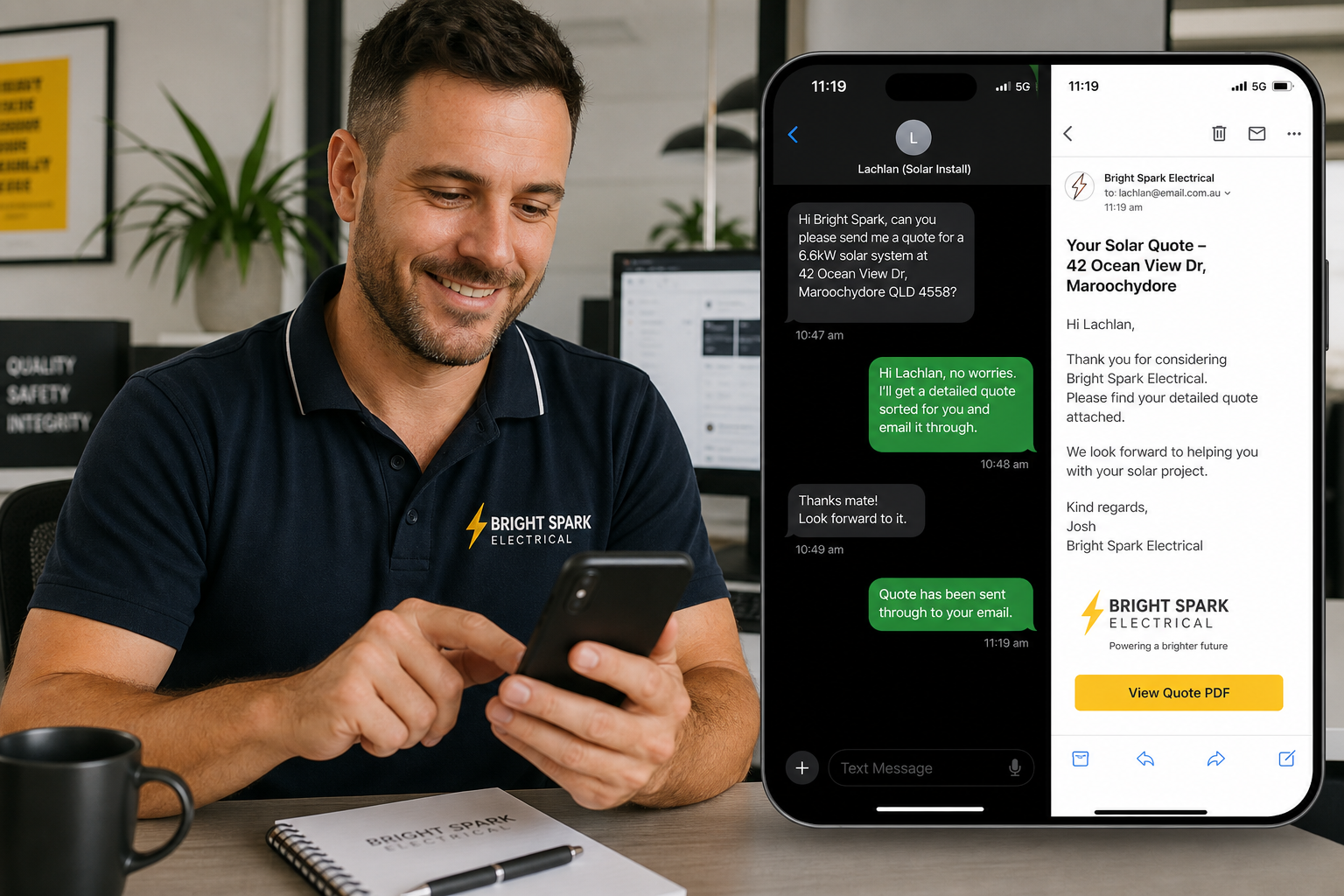
Businesses that send a quote by email and follow up immediately with an SMS (“Hi [Name], I’ve just emailed you our solar proposal — you should have it now. Let me know if you have any questions”) see dramatically higher engagement within the first hour. The SMS triggers the email check.
Businesses that send an SMS with a quote link see high open rates but sometimes lower conversion on very high-value quotes, where customers seem to want the PDF experience for a considered purchase.
The emerging best practice for Australian solar businesses is a combined approach:
- Send the detailed PDF proposal by email
- Immediately follow up with an SMS referencing the email
- Set an automated follow-up SMS at day 3 if the quote hasn’t been accepted
What Actually Gets Quotes Signed: The Factors That Matter More Than Channel
Here is the uncomfortable truth: whether you use SMS or email to deliver a quote matters less than most solar businesses think. The factors that drive quote conversion are:
1. Speed of Quote Delivery
The single biggest determinant of solar quote conversion rate is how quickly you send the quote after the site assessment or initial enquiry.
Research in the home services sector consistently shows that businesses that send quotes within 24 hours convert at significantly higher rates than those who take 3–5 days. The homeowner’s intent is highest immediately after the conversation. Every day that passes, that intent fades and competing options multiply.
With a job management platform like ServiceM8, you can generate and send a quote from the job record on your phone within minutes of leaving the site. You don’t need to be back at a computer. You don’t need to wait for the office to process the information.
For more on how digital job management enables faster quoting, see our guide to operational efficiency for solar businesses.
2. Follow-Up Frequency and Quality
A quote without a follow-up strategy is a quote without a conversion strategy.
Most Australian solar businesses follow up once — usually a week after the quote is sent. This is not enough. Research in solar sales shows that the majority of conversions happen after the third or fourth meaningful contact.
A systematic follow-up sequence — email at day 2, SMS at day 4, educational email at day 7, case study at day 10, final check-in at day 14 — converts significantly more quotes than a single follow-up. We’ve covered this framework in detail in our piece on hidden profit costs for solar installers.
3. Social Proof and Trust Signals
For a residential solar customer making a $12,000 decision, trust is a significant barrier. They’ve received multiple quotes from businesses they’ve never heard of.
Including Google review scores, testimonials from similar customers, and CEC accreditation documentation in your quote builds trust in a way that price alone cannot. Solar businesses with 4.8+ star Google profiles and a clear social proof strategy consistently out-convert competitors on similar pricing.
Automated review collection — asking every completed customer for a review through your job management platform — is how you build this social proof at scale rather than relying on the occasional voluntary reviewer. Our full guide to getting 5-star Google reviews as a tradie covers the strategy and implementation.
4. Clarity of the Proposal
A quote that clearly explains what the customer is getting — system output, equipment quality, installation timeline, what happens after — is more likely to be accepted than one that leads with price.
For solar specifically: explain the estimated annual generation, the expected bill reduction, and the payback period. Show the STC rebate calculation. Specify the warranty on panels, inverter, and installation. Give them a reason to say yes beyond just the number.
The Practical Recommendation: Use Both Channels Strategically
For Australian solar installers and electricians, the optimal quote strategy is:
Email for the formal proposal. Send a professionally formatted PDF or digital quote via email. This is the document they’ll review, share with their partner, and reference when they’re ready to sign.
SMS to drive immediate engagement. Send a brief, personal SMS immediately after the email: “Hi [Name] — your solar quote is in your inbox. Happy to walk you through it if that’s easier — just reply here.”
SMS for follow-up touchpoints. Day 3 SMS if no response. Day 7 email with a case study or testimonial. Day 10 SMS checking if they have questions.
Configure this in your job management system. The best solar and electrical businesses aren’t manually managing this sequence. ServiceM8 handles automated quote follow-up — you set the sequence once, and it runs for every quote, every time, without a team member doing anything.
Getting 5-Star Reviews: The Customer Experience That Makes Everything Easier
There’s a final point worth making about customer experience in the solar and electrical trades.
The businesses that win the most quotes aren’t always the cheapest. They’re the ones with the strongest reputation — and the most visible social proof.
A solar installer with 200 Google reviews at 4.9 stars closes more quotes at the same price than a competitor with 12 reviews at 4.2 stars. Every completed customer represents a review opportunity. The businesses that ask systematically — through an automated post-job review request — build this advantage faster than anyone who relies on manual asking.
Our full guide to getting 5-star Google reviews as a solar or electrical tradie covers exactly how to set this up.
The Bottom Line
SMS gets opened. Email gets read in detail. The businesses converting the most solar and electrical quotes are using both — email for the proposal itself, SMS to drive engagement and manage follow-up touchpoints.
But the channel matters less than the speed, the follow-up discipline, and the social proof you bring to the table.
Start your free ServiceM8 trial — set up quote automation, configure your follow-up sequence, and start collecting Google reviews automatically from completed jobs.
Related reading:
- The Paperless Trade Roadmap: Eliminating Admin Chaos
- 5 Hidden Costs Killing Your Profit as a Solar Installer or Electrician
- ServiceM8 for Solar Installers: The Platform Built for Compliance
- AI Automation for Solar Installers: What Actually Works in 2026
TradieAutomate is an authorised ServiceM8 affiliate. We earn a commission when you sign up through our link — at no extra cost to you. We only recommend platforms we’d use ourselves.