
CCEW NSW: Electrical Certificate of Compliance — $22K Penalty, 7-Day Deadline, Who Issues It
The Certificate of Compliance — Electrical Work (CCEW) — also commonly searched as the NSW electrical certificate of compliance — is the cornerstone compliance document for electrical contractors working in New South Wales. Under the Home Building Act 1989 and the Electricity (Consumer Safety) Act 2004, the CCEW is the legal record that electrical installation work has been performed by a licensed contractor and complies with Australian Standards.
In 2025 and 2026, SafeWork NSW and Fair Trading NSW have increased their compliance focus on electrical contractors — particularly in the solar and battery installation sector, where rapid market growth has led to a mix of highly professional operators and those cutting corners on documentation.
Getting your CCEW obligations right is not complex, but it is non-negotiable. This guide covers everything you need to know.
⚡ Using ServiceM8? Its custom form builder auto-generates CCEW templates from your job data — see how it works for NSW electricians.
ServiceM8 auto-populates CCEW compliance forms directly from site photos on your phone — and reminds you before the 7-day deadline.
What Is the CCEW? (2026 Requirements)
The Certificate of Compliance — Electrical Work (CCEW) is a document that certifies:
- That specific electrical installation work was performed by a licensed contractor
- That the work complies with the Electricity (Consumer Safety) Act 2004 and relevant Australian Standards (primarily AS/NZS 3000, and for solar work, AS/NZS 5033 and AS/NZS 5139)
- The details of the work performed, the property address, and the performing contractor
From 1 July 2026, all CCEWs must be submitted through the BCNSW eCert portal — the mandatory digital lodgement system. Handwritten forms, PDF forms, and previous submission methods are no longer accepted. The BCNSW eCert portal is the only valid submission channel.
When Is a CCEW Required in NSW?
A CCEW is required for all notifiable electrical installation work in NSW. Under the Electricity (Consumer Safety) Act 2004, notifiable work broadly includes:
Residential and commercial electrical installation:
- Installing or altering any fixed electrical wiring in a dwelling
- Installing or modifying switchboards
- Connecting any fixed electrical equipment to the wiring system
Solar and battery installations:
- Installation of any solar PV system connected to the building wiring
- Installation of battery energy storage systems connected to the building wiring
- Connection of an EV charger (EVSE) as a fixed electrical installation
What generally does not require a CCEW:
- Like-for-like replacement of fittings (e.g., replacing a light fitting with an identical unit, using existing wiring)
- Maintenance work that does not alter the installation
If in doubt, issue the CCEW. The consequences of failing to issue a required CCEW far outweigh the minor administrative cost of issuing one that wasn’t strictly required.
Who Can Issue a CCEW in NSW?
Only a licenced electrical contractor can issue a CCEW in NSW — specifically, a contractor holding a current contractor licence issued by NSW Fair Trading under the Home Building Act 1989.
An employee electrician — regardless of their individual licence level — cannot issue a CCEW. The CCEW must be issued by the contracting business (the licensed electrical contractor), not the individual tradesperson who performed the work.
For solar businesses using subcontractors, this creates an important consideration: if you engage a subcontractor (another electrical contractor) to perform installation work, that subcontractor should issue their own CCEW for their work, not you. If you’re the head contractor responsible for the overall installation, understand what compliance documentation your subcontractors are required to provide.
Running a crew? Misclassifying workers (employee vs subcontractor) or getting award rates wrong creates significant back-pay liability alongside your CCEW obligations. See our Electrical Contractor Award Rates 2026 guide for the full pay calculator and compliance breakdown.
NSW Fair Trading CCEW Requirements & Timeframe (2026)
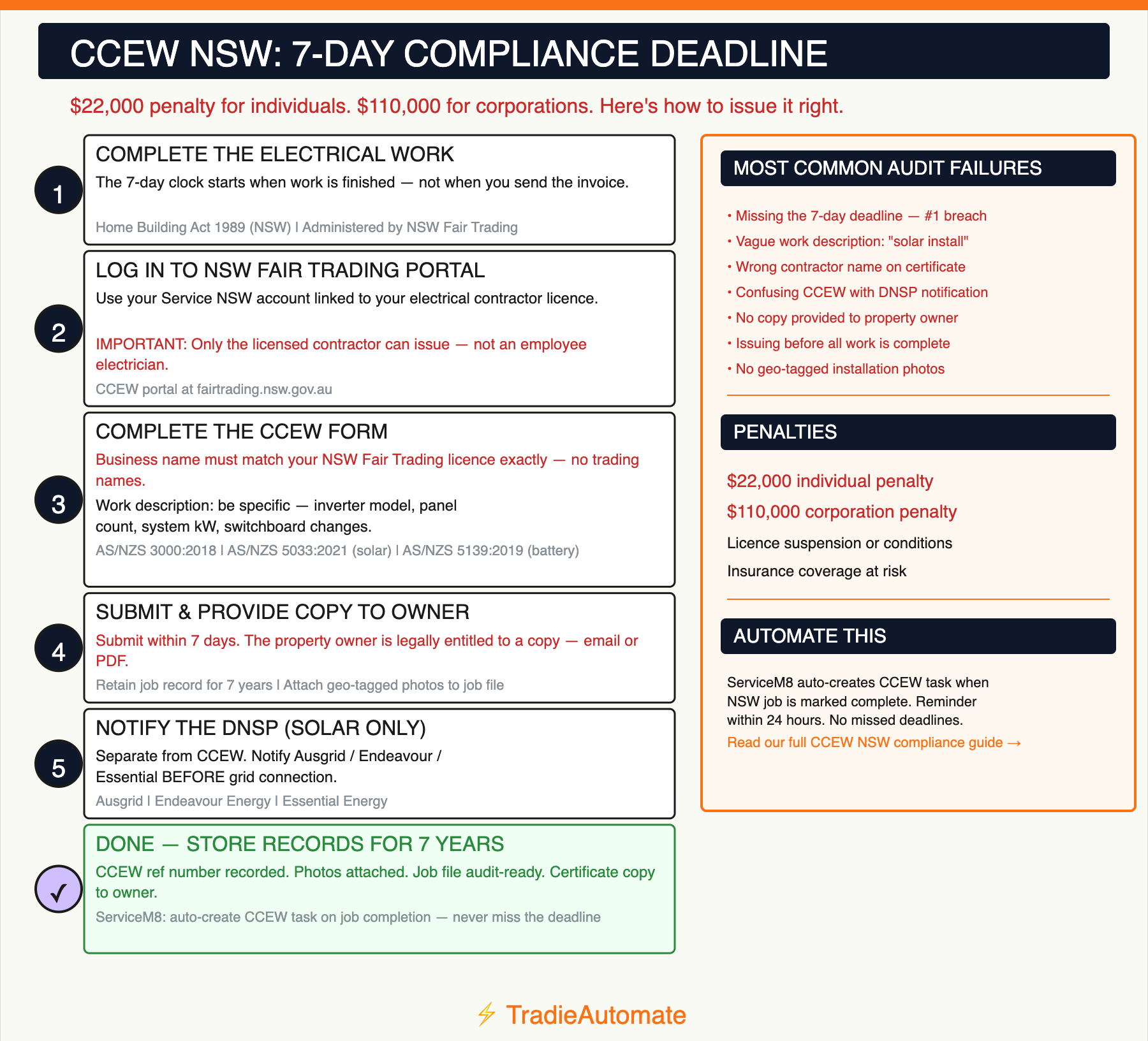
Under NSW requirements, a CCEW must be issued within 7 days of completing the notifiable electrical installation work. For a detailed breakdown of exactly when the 7-day clock starts and what triggers the requirement, see our CCEW 7-day deadline rule guide.
Best practice is to issue within 24–48 hours of completion — while the installation details are fresh, photos are uploaded, and documentation is complete. Waiting until day 6 creates unnecessary risk.
Penalties for missing the 7-day deadline: NSW Fair Trading can issue penalty infringement notices of up to $22,000 for individuals and $110,000 for corporations under the Home Building Act 1989. In 2026, Fair Trading has signalled increased enforcement of CCEW deadline compliance, and repeat offenders face mandatory licence review with potential conditions or suspension.
Two separate obligations for solar installations:
- CCEW — must be issued to NSW Fair Trading within 7 days of completing the electrical installation work
- Network notification — must be submitted to the relevant DNSP (Ausgrid, Endeavour Energy, or Essential Energy) before connection to the grid
These are independent requirements to separate bodies. Issuing the CCEW does not satisfy the network notification obligation, and vice versa. Many electricians confuse the two — don’t be one of them.
What Must the CCEW Include?
A compliant NSW CCEW must include:
Contractor information:
- Name of the licensed electrical contractor (business name)
- Contractor licence number (issued by NSW Fair Trading)
- Contractor address and contact details
Property information:
- Full address of the property where work was performed
- Name of the property owner (or occupier where different)
Work description:
- Detailed description of the electrical installation work performed
- For solar: panel brand/model, number, inverter brand/model, system capacity (kW), installation location on property
- For battery: battery brand/model, capacity (kWh), installation location
- Date work was completed
Compliance declaration:
- Declaration that the work complies with the Electricity (Consumer Safety) Act 2004 and relevant Australian Standards
- Date of issue
BCNSW eCert Portal — Mandatory Digital CCEW Submission
As of 1 July 2026, the BCNSW eCert portal is the only valid submission channel for all CCEWs in NSW. This is a hard regulatory change — not a preference.
The following submission methods are no longer accepted:
- CCEW PDF forms (previously available on the NSW Fair Trading website)
- Essential Energy portal lodgements
- Hard copy / NECA book forms (the carbon-paper pads many electricians kept in the van)
What this means for your business:
- If you haven’t registered for a BCNSW eCert account yet, you cannot submit CCEWs legally after 1 July 2026
- Any CCEW submitted via old methods (PDF, Essential Energy portal, paper) is treated as not submitted — penalties apply
- The BCNSW eCert portal auto-distributes copies to the customer (via email), the relevant DNSP, and Building Commission NSW — eliminating the multi-party distribution headache
Registration is free. The portal is at ecert.buildingcommission.nsw.gov.au. You need your contractor licence details and a Service NSW account linked to your licence.
For compliance-heavy electrical businesses: If you submit 10+ CCEWs per month, the portal’s batch-upload and pre-fill features will save hours over the old manual methods. The mandatory transition is actually a workflow improvement — but only if you register and learn the system before you need it for a live job.
Working across NSW and VIC? Victoria’s equivalent system is ESV Connect for CES lodgement. See our CES Victoria complete guide for the side-by-side comparison of both state portals.
How to Issue a CCEW via BCNSW eCert
- Register at ecert.buildingcommission.nsw.gov.au (free — you need your contractor licence and a Service NSW account)
- Log in and select “Create new CCEW”
- Complete all fields: contractor details, property address, work description, compliance declaration
- Submit — the system generates a certificate reference number and auto-distributes copies to the customer (if email provided) and the relevant DNSP
- Download and retain a copy for your job records
CCEW and Solar — Specific Requirements
For solar PV installation in NSW, the CCEW obligation exists alongside several other compliance requirements that operate separately:
Network notification
Before connecting a solar system to the grid, the relevant distribution network service provider (DNSP) must be notified:
- Ausgrid territory (Sydney, Central Coast, Hunter): Ausgrid connection application portal
- Endeavour Energy territory (greater western Sydney, Blue Mountains, Wollongong): Endeavour Energy portal
- Essential Energy territory (regional/rural NSW): Essential Energy portal
Network notification is required before connection, not after — it’s not a post-installation compliance item.
AS/NZS 5033 installation records
Your installation must comply with AS/NZS 5033:2021 (the solar PV installation standard). Documentation of compliance — string sizing calculations, labelling records, installation photos — should be retained even though they don’t form part of the CCEW submission.
AS/NZS 5139 for battery
Battery installations require compliance with AS/NZS 5139:2019. The battery clearance compliance, ventilation assessment, and commissioning records should be documented and retained alongside the CCEW.
See our solar compliance checklist and AS/NZS 5139 guide for the complete compliance picture.
Building CCEW Compliance Into Your Job Workflow
The most reliable way to ensure every job gets a CCEW issued correctly and on time is to build it into your job completion workflow — not rely on memory.
In ServiceM8, set up:
- A mandatory job completion checklist item: “CCEW issued — reference number recorded”
- A follow-up task created automatically when a NSW job is marked complete, due within 14 days, for CCEW confirmation
- A notes field for the CCEW certificate number and issue date, stored against the job record
For businesses working across both NSW and VIC (or other states), your job management system should prompt the appropriate certificate type based on the job’s state — CES for VIC, CCEW for NSW, CoTC for QLD.
Choosing your platform? ServiceM8 is the strongest option for compliance-heavy electrical work — see our ServiceM8 for Electricians deep-dive and the full job management software comparison for Australian sparkies.
Common CCEW Audit Failures — What Gets Contractors Caught in 2026
SafeWork NSW and NSW Fair Trading receive complaints and conduct audits. These are the failure patterns that consistently appear in compliance outcomes:
Audit cost reality: A SafeWork NSW or Fair Trading audit triggered by a complaint or random selection costs a typical electrical contracting business $3,000–$8,000 in management time, legal advice, and compliance rectification — even when no penalty is ultimately issued. For audits that uncover systemic failures, the combined cost of penalties, rectification, and operational disruption frequently exceeds $25,000. In 2026, the audit rate for electrical contractors in the solar and battery sector has increased significantly compared to 2024 levels.
1. Missing the 7-day deadline The most common breach — and the easiest to prevent. The 7-day clock starts at job completion, not when you send the invoice. Set a job management system reminder at the point of sign-off. Contractors who batch CCEW issuance at the end of the week regularly miss the window when jobs complete on a Friday or public holiday eve.
2. Vague or incomplete work description “Electrical installation” or “solar installation” is not sufficient. A valid CCEW work description must be specific enough for an auditor to understand exactly what was installed and where. For solar: panel count, panel brand and model, inverter brand and model, total system size in kW, whether there’s a battery, battery brand and kWh rating, and the type of grid connection. For switchboard work: circuit count, breaker specifications, RCD types installed.
3. Wrong contractor name or licence number The CCEW must use the exact business name as it appears on your NSW Fair Trading contractor licence — not a trading name, abbreviation, or the individual electrician’s name. A CCEW issued under a trading name not matching the registered licence name is technically defective.
4. Confusing CCEW with DNSP notification Issuing the CCEW satisfies the NSW Fair Trading obligation. It does not notify the DNSP (Ausgrid, Endeavour Energy, or Essential Energy). These are separate obligations to separate bodies. Many contractors make this error and receive complaints from DNSPs about unnotified connections.
5. No copy provided to the property owner The property owner is legally entitled to receive a copy of the CCEW. Failing to provide it is a separate compliance failure under the Home Building Act. If the homeowner later sells or refinances, a missing CCEW becomes their problem — and they will trace it back to you.
6. Issuing before work is complete A CCEW certifies that work has been completed and is compliant. Issuing one before all punchlist items are done is a false certification — potentially exposing you to disciplinary action and voiding insurance coverage.
7. Poor photo documentation for solar While photos aren’t part of the CCEW itself, NSW Fair Trading and DNSPs increasingly cross-reference CCEW records against installation photos during solar audits. A CCEW with no corresponding job documentation is a red flag. Geo-tagged, timestamped photos should be stored against every job.
Working across state lines? Victoria’s CES system has different deadlines (30 days), different regulator (Energy Safe Victoria), and different audit triggers. See our CES Victoria complete guide for the side-by-side comparison — getting this wrong when your crews cross the Murray is a material compliance risk.
Need to check a CCEW requirement right now? Ask Tradie Brain AI free → Instant answers on CCEW lodgement, network notification rules, solar documentation requirements, and more. No login required.
Consequences of Non-Compliance (2026 Penalties)
Fair Trading penalties: NSW Fair Trading can issue penalty infringement notices for CCEW failures and refer serious cases for prosecution. Under the Home Building Act 1989, maximum penalties reach $22,000 for individuals and $110,000 for corporations per offence. In 2026, Fair Trading has indicated it will pursue maximum penalties for systematic non-compliance rather than defaulting to the lower end of the range.
Licence risk: Repeated or serious non-compliance can result in contractor licence suspension or conditions. The administrative cost of a suspended licence — even for 30 days — typically exceeds $15,000–$25,000 in lost revenue for a mid-sized electrical contracting business operating in 2026.
Insurance exposure: Work performed without a CCEW may create issues with professional indemnity insurance coverage in the event of an incident.
Property owner disputes: A homeowner attempting to sell or refinance a property may discover no CCEW on record for an electrical installation — creating a dispute with the installing contractor.
This article provides general information only and does not constitute legal advice. Requirements are subject to legislative change — always verify current obligations with NSW Fair Trading (fairtrading.nsw.gov.au) and SafeWork NSW.
Tradie Brain AI has instant answers on CCEW lodgement, 7-day deadline rules, network notification, solar documentation, and SafeWork NSW requirements. No login required.
The Sparky’s Playbook — the free 12-chapter guide for Australian electricians covering licensing, EV charging, commercial solar, cash flow, tech stack, and building a business worth selling. Download free →
Related Reading
- Certificate of Electrical Safety (CES) — Complete Guide for Victorian Electricians
- Staying Compliant in 2026: The Complete Safety and Compliance Guide
- Solar Compliance Checklist for Australian Installers (2026)
- AS/NZS 5139 Battery Storage Compliance: What Every Solar Installer Needs to Know
- ServiceM8 for Electricians: The Job Management Platform Australian Sparkies Actually Use
- AI Automation for Trade Businesses: The 2026 Guide
- How to Get More Solar Leads in Australia (2026 Guide)
- Full ServiceM8 Review 2026: Is It Worth It?
- ServiceM8 vs simPRO 2026: Australia’s Honest Comparison
- The Paperless Trade Business Roadmap: From Paper Forms to Digital Ops
- EV charger network installation business opportunity
FAQ
What is a CCEW in NSW and when is it required?
A Certificate of Compliance — Electrical Work (CCEW) is a legal document that a licensed electrician in NSW must issue after completing electrical installation or alteration work. It is required any time you connect, disconnect, or alter electrical wiring — including solar installations, switchboard upgrades, EV charger installations, and air conditioning wiring. The CCEW must be issued within 7 days of completing the work and sent to both the property owner and Ausgrid/Endeavour/Essential Energy as applicable.
Who can issue a CCEW in NSW?
Only a licensed electrical contractor or a licensed electrician working under a contractor’s licence can issue a CCEW in NSW. The licence is issued by NSW Fair Trading. If you are an electrical worker (not a contractor), you cannot issue the certificate in your own name — the contractor of record must issue it. Penalties for failing to issue a CCEW or issuing one incorrectly can reach $22,000 for individuals and $110,000 for corporations under the Home Building Act 1989.
What happens if you don’t issue a CCEW within 7 days in NSW?
Failing to issue a CCEW within 7 days of completing the work is a breach of the Home Building Act 1989. NSW Fair Trading can issue a formal warning, compliance notice, or financial penalty. Repeat non-compliance can trigger a licence review. In practice, some electricians unknowingly breach this regularly — particularly on large multi-job weeks where paperwork piles up. Using a job management app like ServiceM8 to trigger CCEW preparation as part of the job completion workflow prevents these oversights.
Does a CCEW need to be issued for solar installations in NSW?
Yes. Any solar PV installation that involves electrical connection work requires a CCEW in NSW. This includes the AC wiring from the inverter to the switchboard, any switchboard modifications, and the grid connection. The CCEW must be issued within 7 days and notified to the appropriate DNSP (Ausgrid, Endeavour Energy, or Essential Energy). In addition to the CCEW, solar installers must lodge STC documentation with the Clean Energy Regulator and meet CEC accreditation requirements.
What information must be included on a NSW CCEW?
A valid NSW CCEW must include: the contractor’s licence number, the property address, a description of the electrical work performed, the date of completion, confirmation that the work complies with AS/NZS 3000 Wiring Rules and relevant standards, and the contractor’s signature. For solar installations, it should also reference the grid connection type and inverter specifications. Incomplete CCEWs are one of the most common triggers for NSW Fair Trading compliance audits.
Related: If you’re preparing for a SafeWork or ESV safety audit, download our free Electrical Safety Audit Prep Checklist — 6 categories of documentation auditors check, state-by-state deadlines, and a printable one-pager.
Got a compliance question? Ask Tradie Brain AI — free, no login. Instant answers on CCEW, CER audits, and AS/NZS standards.